
Women’s Pickleball: What Player Counts, Event Entries and Rankings Measure
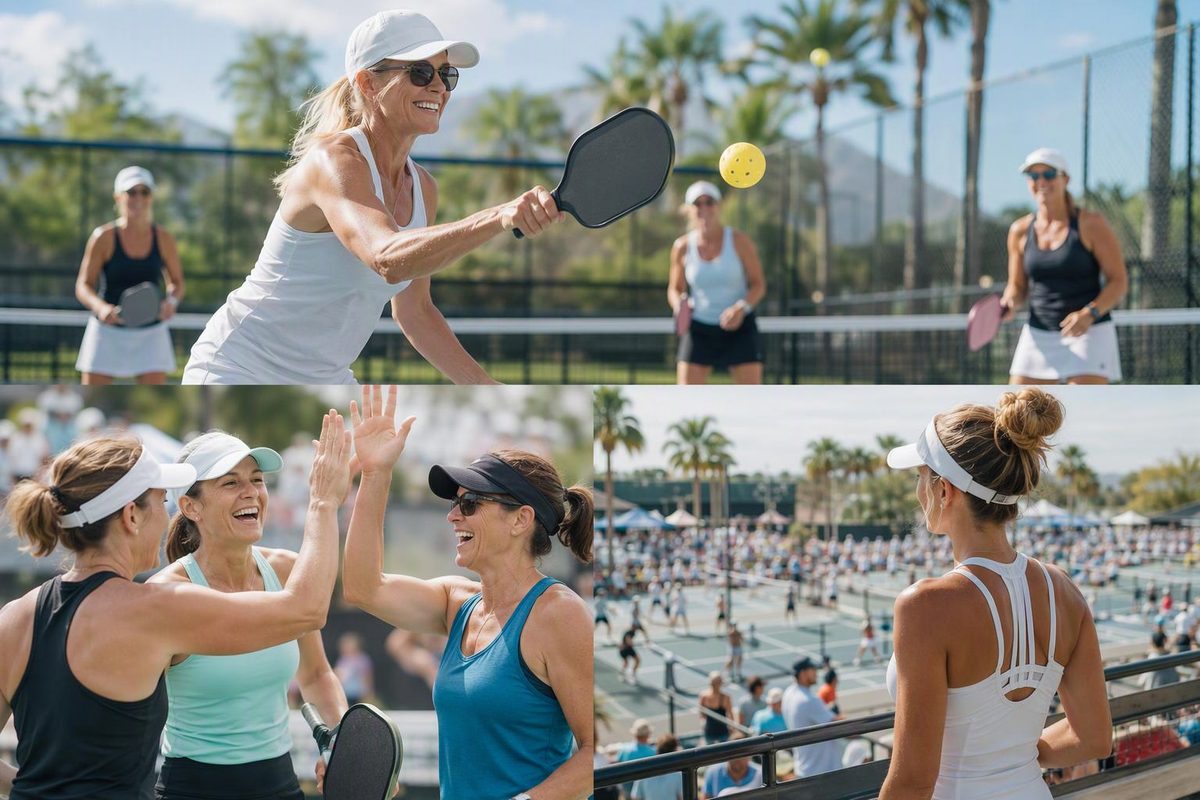
Separate women’s pickleball participation estimates from tournament teams, unique competitors and pro rankings—with a worked entry-count example.
A national player estimate, a women’s doubles draw and a professional leaderboard measure different things. To describe women’s pickleball accurately, first decide whether you mean everyone who played, people competing in an event or ranked professionals.
National participation: women and girls who played
The Sports & Fitness Industry Association (SFIA) estimates that ~24.3 million Americans played pickleball in 2025 and publishes a rounded gender split of 43% female and 57% male. Its survey population is ages six and older, so the female share includes girls, not just adult women. These are 2025 participation figures in the 2026 reporting cycle—not a full-year 2026 count. Source: SFIA
Multiplying the two rounded inputs gives ~24.3 million × ~43% = ~10.4 million female participants. This is our calculation, not a separately published SFIA headcount. It is neither a frequent-player total nor a count of league or tournament registrations.
For the more precise reported share, historical comparison and calculation detail, see our women’s participation percentage explainer.
Tournament participation: teams, entries or unique players?
Under the 2026 USA Pickleball Official Rulebook, tournament categories include women’s singles, women’s doubles and mixed doubles. Open gender and age events allow players of any gender and age. These categories matter when interpreting entry totals. Source: Section 15.A
| Event | Players on each side | How to interpret an entry total |
|---|---|---|
| Women’s singles | One female player | Each singles entry represents one player in that event |
| Women’s doubles | Two female players | Each team represents two female player entries |
| Mixed doubles | One male and one female player | Each team represents one female player entry |
For example, 20 women’s doubles teams represent 40 player entries in that bracket. If all 40 players also enter singles, the two brackets contain 80 player entries—but still only 40 unique people.
A defensible tournament total therefore needs to say whether it counts teams, player entries or unique players. To measure all female competitors, include those in mixed doubles and any open-gender events, not merely women-only brackets. Then deduplicate across events: adding bracket totals can count the same person more than once.
Registration totals also need a clear label. Players entered are not necessarily players who actually competed; a participation count should state how withdrawals and no-shows were handled.
Pro rankings: performance, not population
Professional standings answer a different question: how players performed within a ranking system.
The PPA Tour describes its World Pickleball Ranking as a composite across singles, gender doubles and mixed doubles, using a weighted point system based on PPA Tour points earned over the preceding 52 weeks. It is not a census of professional women, much less all women who play. Source: PPA Tour
For a leaderboard comparison, specify the tour, discipline, ranking method and date. Our pickleball ranking guide separates the published women’s and men’s standings from other ranking and rating systems.