
Pickleball vs. Basketball Court Size: Compare Lines, Not Just Area
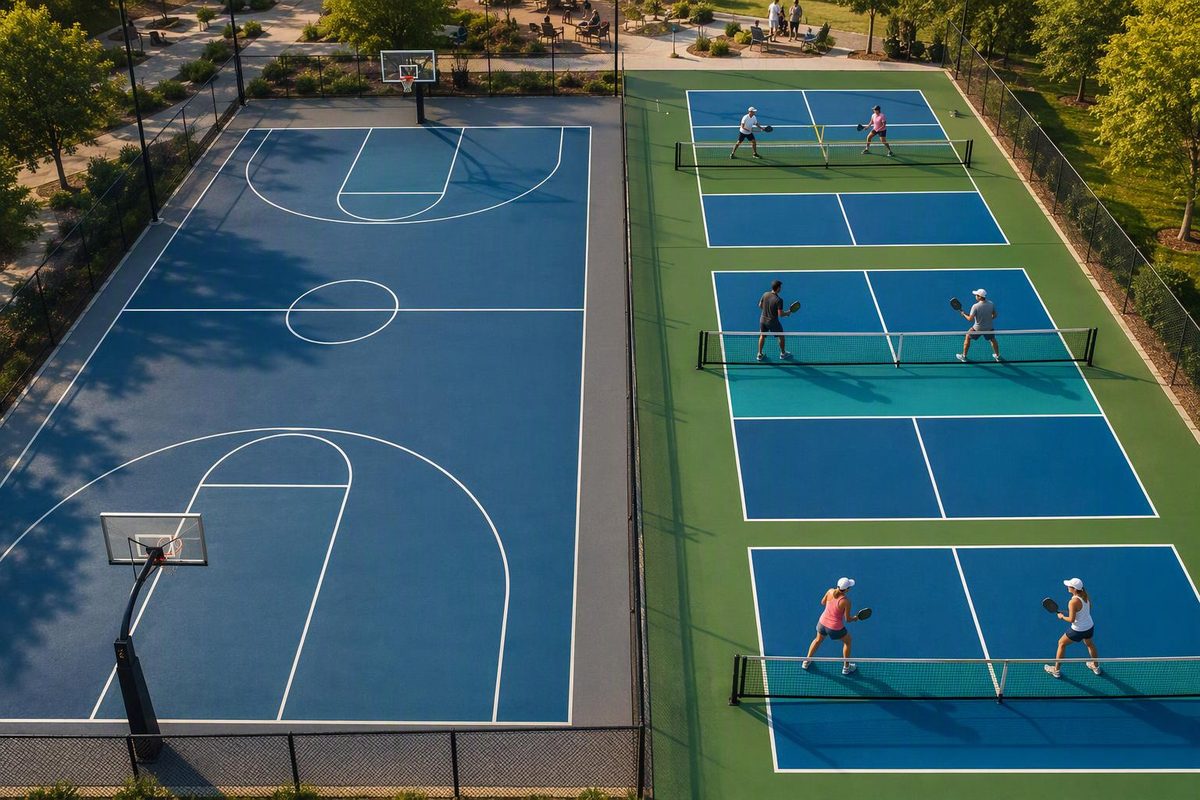
Compare pickleball and basketball court dimensions, area ratios and half-court fit—and see why four sets of lines do not mean four playable courts.
A pickleball court is 20 × 44 feet, or 880 square feet. An NBA basketball court is 50 × 94 feet, or 4,700 square feet. Comparing those court rectangles, pickleball occupies ~19% of the area of an NBA court; basketball is ~5.34 times as large. The dimensions come from USA Pickleball’s court guidance and The Hoops Geek’s basketball dimension guide; the areas and ratios are calculated here.
That answers the size comparison—but not how many pickleball courts a basketball facility can accommodate. For that, you need the surrounding playing space, not just the painted lines.
Court dimensions side by side
All dimensions below are width × length. These are court rectangles, excluding surrounding run-off space, seating and circulation.
| Court or comparison area | Dimensions | Calculated area | Pickleball’s 880 sq ft as a share |
|---|---|---|---|
| Pickleball, singles or doubles | 20 × 44 ft | 880 sq ft | 100% |
| NBA / NCAA men’s basketball, full court | 50 × 94 ft | 4,700 sq ft | ~19% |
| High-school basketball, ideal court | 50 × 84 ft | 4,200 sq ft | ~21% |
| Half of an NBA-size basketball court | 50 × 47 ft | 2,350 sq ft | ~37% |
USA Pickleball specifies the same court dimensions for singles and doubles in its 2026 rulebook, Rule 3.A.1. The 2026–27 NCAA men’s rulebook, Rule 1, Section 2, specifies a 94 × 50-foot court, matching the NBA dimensions listed above. The high-school figure is an ideal measurement, not a claim that every school has that size: Draper’s published high-school court specifications identify the 84 × 50-foot ideal while allowing other dimensions. The NBA half-court row simply halves the full court’s length.
In linear terms, pickleball is 40% as wide and ~47% as long as an NBA court. “About one-fifth the area” is therefore more accurate than “half the size.”
The pickleball footprint is larger than 880 square feet
The court is the rectangle bounded by the lines. The playing surface includes the surrounding area designated for play.
USA Pickleball’s 2026 rulebook, Rule 3.A.3, specifies:
- Minimum playing surface: 30 × 60 feet, totaling 1,800 square feet.
- Recommended for new construction and tournament play: 34 × 64 feet, totaling 2,176 square feet.
With the lined court centered, the minimum footprint provides 5 feet beyond each sideline and 8 feet behind each baseline. The new-construction recommendation provides 7 feet and 10 feet, respectively. Those margins are calculated from the rulebook dimensions.
Neither footprint is a complete facility space allowance. Keep seating, storage and access routes outside the area reserved for play. Our pickleball facility spacing guide explains those additional allowances.
How many pickleball courts fit on a basketball court?
There is no reliable universal count without measuring the usable floor or slab. A basketball court’s boundary lines are not necessarily the edges of its facility.
Here is why an area-only calculation fails:
4,700 ÷ 880 = ~5.34 pickleball court areas.
That does not mean five usable courts fit. It ignores both rectangular layout and run-off space.
For a concrete example, four 20 × 44-foot lined courts can be drawn crosswise in an 80 × 44-foot bank inside a 94 × 50-foot basketball rectangle. But with no gaps between those four courts and the bank centered, there would be:
- No separation between neighboring pickleball sidelines.
- Only 3 feet behind each pickleball baseline before reaching the basketball sidelines.
That is a lines-only packing example, not a layout meeting the minimum pickleball playing-surface dimensions.
One 30 × 60-foot minimum footprint—or one recommended 34 × 64-foot footprint—fits within the full basketball rectangle. But two separate minimum footprints need 60 × 60 feet side by side, or 30 × 120 feet end to end. Neither of those arrangements fits wholly inside a 50 × 94-foot rectangle. A larger gym floor or outdoor slab may provide the missing space—but measure it rather than assuming it exists.
Does pickleball fit on a basketball half court?
The lines fit on half of an NBA-size court; the minimum playing-surface footprint does not. A 20 × 44-foot rectangle fits within 50 × 47 feet. A 30 × 60-foot footprint does not fit in a conventional layout aligned with those boundaries.
For a conversion, record the clear usable dimensions, including space beyond the basketball lines. Check walls, fences, hoop supports, net bases and routes used by people moving between courts before selecting a layout.
When reporting the result, distinguish pickleball line markings from courts available for simultaneous play. That distinction matters to infrastructure figures just as much as the difference between dedicated public courts and broader court counts.