
What the New Paddle Spin Test Measures—and What It Does Not
Applies to a controlled certification procedure, not player-generated shot spin; previously certified paddles stay under their original standards.
USA Pickleball has announced a maximum result of 2,100 revolutions per minute (RPM) for its new paddle-certification spin test. The test is scheduled to become mandatory for new certifications on October 1, 2026. As of September 20, 2026, that date remains prospective. The threshold applies to a controlled laboratory procedure—not to the spin a player may generate during a rally—and previously certified paddles will remain subject to the standards in effect when they were certified, according to USA Pickleball’s implementation announcement.
The short answer: 2,100 RPM is a paddle-certification threshold
Threshold: 2,100 RPM Subject: New USA Pickleball paddle certifications Planned start: October 1, 2026 Not covered: A player’s in-match spin output
These details come from USA Pickleball’s announced implementation policy linked above.
The pickleball 2,100 RPM spin limit measures how much rotation a paddle imparts to a ball under prescribed certification-test conditions. It does not prohibit a player from producing a shot measured above 2,100 RPM, and it does not establish a universal limit for every club, league, tournament or governing body.
That distinction matters because RPM is an output of the complete test setup. The ball, impact conditions, paddle orientation, conditioning, valid-trial rules and calculation method can all affect the reported result. A certification reading is meaningful only within the protocol that produced it.
For the same reason, a consumer review reporting 2,300 RPM does not by itself establish that the paddle would fail USA Pickleball certification. A player-swing test, a reviewer’s launcher-based test and a stationary-paddle certification procedure may all measure rotation, but their results are not necessarily comparable when their methods differ.
The precise statement is therefore not “this paddle cannot generate more than 2,100 RPM.” It is: a paddle subject to the new USA Pickleball certification procedure must produce a qualifying result of no more than 2,100 RPM under that procedure.
A dated timeline of the announced change
The announcement, procedural milestones and planned effective date are separate events:
- July 8, 2026: USA Pickleball announced the 2,100 RPM maximum and its planned implementation schedule.
- July 15, 2026: Official test procedures were scheduled for distribution. The announcement establishes the scheduled date but does not confirm that distribution subsequently occurred.
- Before October 1, 2026: Manufacturers may submit paddles voluntarily for the spin-rate test.
- Through September 30, 2026: Paddles could continue to qualify under the existing surface-roughness and coefficient-of-friction tests, according to The Dink’s July 8 report on the transition.
- October 1, 2026: The spin test is scheduled to become mandatory for new USA Pickleball paddle certifications.
The July 8 announcement, July 15 procedural date, voluntary-testing period and October 1 planned start are set out in USA Pickleball’s implementation notice cited above. Because October 1 remains in the future as of September 20, the requirement should be described as announced or scheduled, not as an implementation already completed.
The supplied evidence does not settle how a boundary case will be handled if a paddle is submitted, tested or certified exactly on October 1. Those events should not be assumed to be equivalent. A manufacturer facing that situation should consult the current controlled procedure and obtain guidance from USA Pickleball.
How USA Pickleball says the spin test works
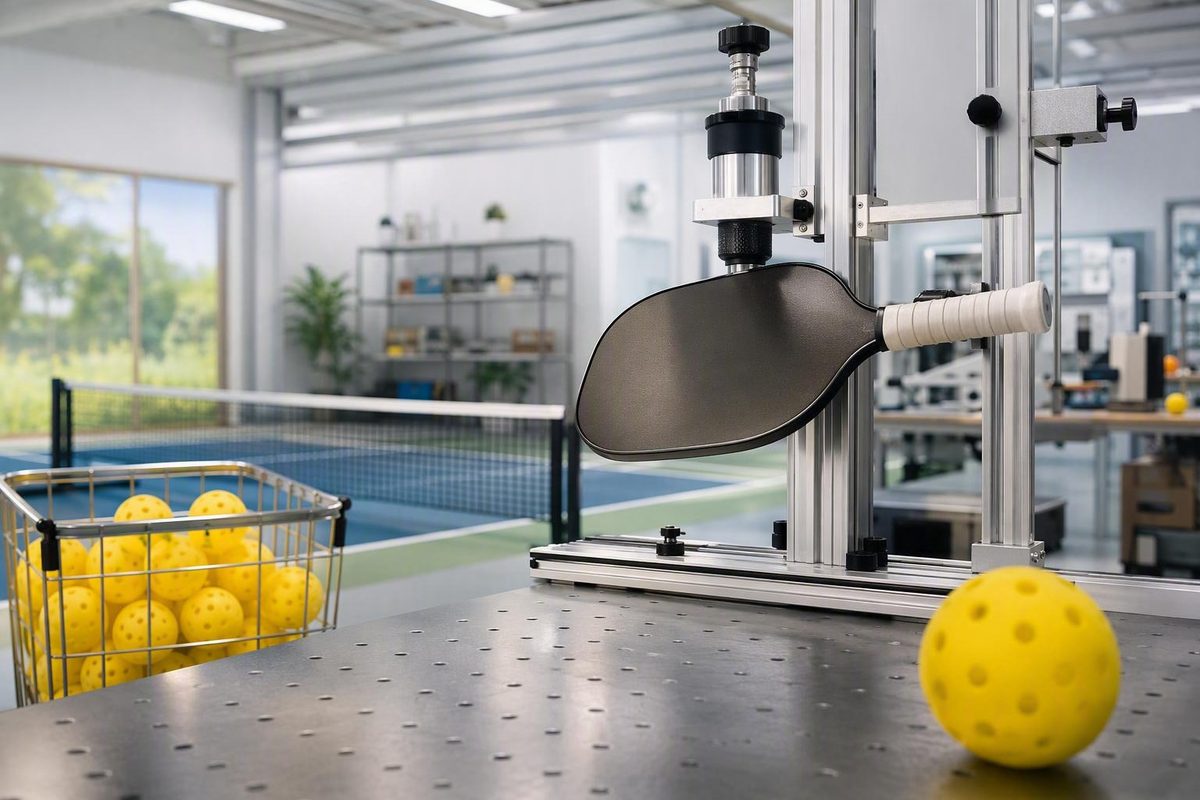
USA Pickleball describes a direct measurement process:
- A specially marked pickleball is fired from a ball cannon.
- The ball travels toward a stationary paddle.
- Two cameras track markers on the ball as it moves and interacts with the paddle.
- Motion-analysis software processes the marker data and calculates the resulting rotation in RPM.
Image Systems developed the motion-tracking and RPM-calculation technology. Franklin Sports worked with USA Pickleball on manufacturing the marked test ball, including the placement and alignment of the tracking targets. USA Pickleball’s technical account of the ball and tracking system says the software processes the marker data automatically rather than relying on manual interpretation.
The methodological change is important because it measures the outcome—ball rotation after impact—instead of relying only on surface roughness or coefficient of friction as proxies for spin potential. Surface measurements may still provide manufacturing information, but neither metric alone measures the ball’s resulting RPM.
| Disclosed | Not established by the supplied official evidence |
|---|---|
| Specially marked test ball | Launch speed |
| Ball fired from a cannon toward a stationary paddle | Paddle angle and orientation |
| Dual-camera marker tracking | Ball conditioning and environmental controls |
| Automated software calculation of RPM | Number of impacts and valid-impact rules |
| Image Systems tracking technology | Averaging and pass/fail calculation |
| Franklin manufacturing work on the marked ball | Uncertainty range and independent reproducibility results |
USA Pickleball says automation is intended to support consistency, repeatability and reproducibility. Those are the organization’s stated design goals. The supplied official material does not provide a validation dataset, uncertainty range or independent cross-laboratory results demonstrating the system’s performance.
Does an already approved paddle have to pass the new test?
No automatic spin retest is announced for every paddle certified before the planned change. USA Pickleball says previously certified paddles remain subject to the standards in effect when they were certified.
That policy should not be broadened into a guarantee that every older paddle will remain eligible indefinitely or in every competition. Players still need to check the model’s current status in the relevant approval system and the equipment rules for the event they are entering.
| Paddle or setting | Effect of the announced change | What to verify |
|---|---|---|
| Previously USA Pickleball-certified model | No automatic retest under the new 2,100 RPM requirement | Current USA Pickleball approval status and event rules |
| New USA Pickleball certification from the planned effective date | Must meet the 2,100 RPM certification threshold | Applicable procedure and final approval status |
| Professional PPA or MLP competition | Separate UPA-A eligibility applies | Current UPA-A approval and event requirements |
For tournament play, verify the exact model rather than relying on a brand name. A retailer listing, old product label or independent review may be outdated, may refer to another model variant or may address a different approval system.
No model should be described as passing or failing the forthcoming USA Pickleball spin test without an official result produced under the applicable procedure. Independent RPM measurements are not substitutes for certification records.
USA Pickleball and UPA-A: the same number, separate approvals
USA Pickleball and the United Pickleball Association of America operate separate paddle-approval systems. The Dink reported that UPA-A’s professional equipment guidelines set a maximum measured spin rate of 2,100 RPM for professional competition, including PPA and MLP events. Its summary of the UPA-A paddle guidelines identifies both the professional scope and the reported ceiling.
| Organization | Scope | Reported ceiling | Timing, earlier approvals and evidence limits |
|---|---|---|---|
| USA Pickleball | New paddle certifications | 2,100 RPM | Mandatory testing is scheduled for October 1, 2026. Earlier paddles remain subject to the standards in effect when certified. Full public protocol and validation data are limited. |
| UPA-A | Professional equipment approval, including PPA and MLP competition | 2,100 RPM | The supplied secondary evidence reports the ceiling but does not establish the complete test protocol. Sources conflict on its historical start date, and earlier-approval treatment is not established here. |
The numerical match does not demonstrate that the two organizations use identical test balls, impact conditions, sample counts, calculations, uncertainty allowances or ongoing compliance processes. Nor does it make approval by one organization transferable to the other.
The operational rule is simple: USA Pickleball approval should not be represented as UPA-A approval, and UPA-A approval should not be represented as USA Pickleball approval. Players need the approval status required by the competition they are entering.
What the available data cannot tell us yet
No supplied source establishes how many existing or future paddle models would exceed 2,100 RPM under USA Pickleball’s prescribed procedure. Independent RPM lists cannot provide that answer unless their equipment, conditions, sampling and calculations match the certification protocol.
USA Pickleball reported 718 paddle approvals in 2025, among 790 equipment approvals that also included 72 balls. Its 2025 annual growth report provides context for the scale of certification activity, but 718 is not the number of paddles that will undergo the new test, fail it or be removed from approval.
The available evidence also does not establish that 2,100 RPM is the optimal threshold. USA Pickleball has framed the test around consistency, repeatability, fair competition and responsible innovation. Those are stated goals, not independent findings that this cutoff produces the best competitive balance.
Measurement uncertainty matters near any hard threshold. Consider nominal results of 2,095 RPM and 2,105 RPM. They fall on opposite sides of the line, but their practical distinction cannot be assessed without information about repeatability, cross-laboratory reproducibility, the pass/fail calculation and variation among production samples of the same model.
After the planned launch, the principal points to monitor are:
- the current controlled test procedure;
- official confirmation that mandatory testing began as scheduled;
- required orientations, trial counts and averaging rules;
- treatment of invalid impacts;
- measurement uncertainty and cross-laboratory reproducibility;
- ball conditioning and environmental controls;
- treatment of paddle break-in and wear;
- variation among production samples;
- additions to or changes in the official approval list; and
- any paddle-level results tied to the applicable protocol.
A sound post-launch update should first confirm implementation after October 1, review the current governing documents and compare approval-list activity before and after the change. Model-level pass-or-fail claims should wait for protocol-matched certification records.
The usable takeaway is straightforward: 2,100 RPM is an announced laboratory threshold for new USA Pickleball paddle certifications scheduled from October 1, 2026. It is not an on-court spin cap for players, and the announcement does not impose a retroactive spin test on every previously approved paddle. Test protocol, certification status and governing body remain separate facts.
Can a reviewer’s 2,300 RPM result prove that a paddle violates the 2,100 RPM limit?
No. A reviewer’s 2,300 RPM result establishes what that reviewer’s method measured. It does not establish a USA Pickleball certification failure unless the equipment, conditions, valid-trial rules and calculations match the official procedure.
The result may still be useful for comparing paddles tested consistently within the reviewer’s system. It should not be relabeled as an official compliance result.
Do USA Pickleball’s 718 paddle approvals in 2025 show how many paddles will be affected?
No. The 718 figure is USA Pickleball’s reported count of paddle approvals during 2025, as documented in the annual report cited above. It does not identify how many were unique models still being manufactured, how many will be submitted again, how many future paddles will undergo the spin test or how many would exceed 2,100 RPM.
It is a certification-volume figure, not a forecast of affected or failing paddles.
What happens to a paddle submitted or certified exactly on October 1, 2026?
The official announcement schedules mandatory testing for new certifications from October 1, but the supplied evidence does not establish whether submission date, test date and certification date are treated identically in a boundary-date case.
A manufacturer should consult the current controlled procedure and seek direction from USA Pickleball. Players should rely on the model’s current approval status and their event’s rules rather than inferring eligibility from a submission date alone.