
What a Pickleball Court Really Costs, Line Item by Line Item
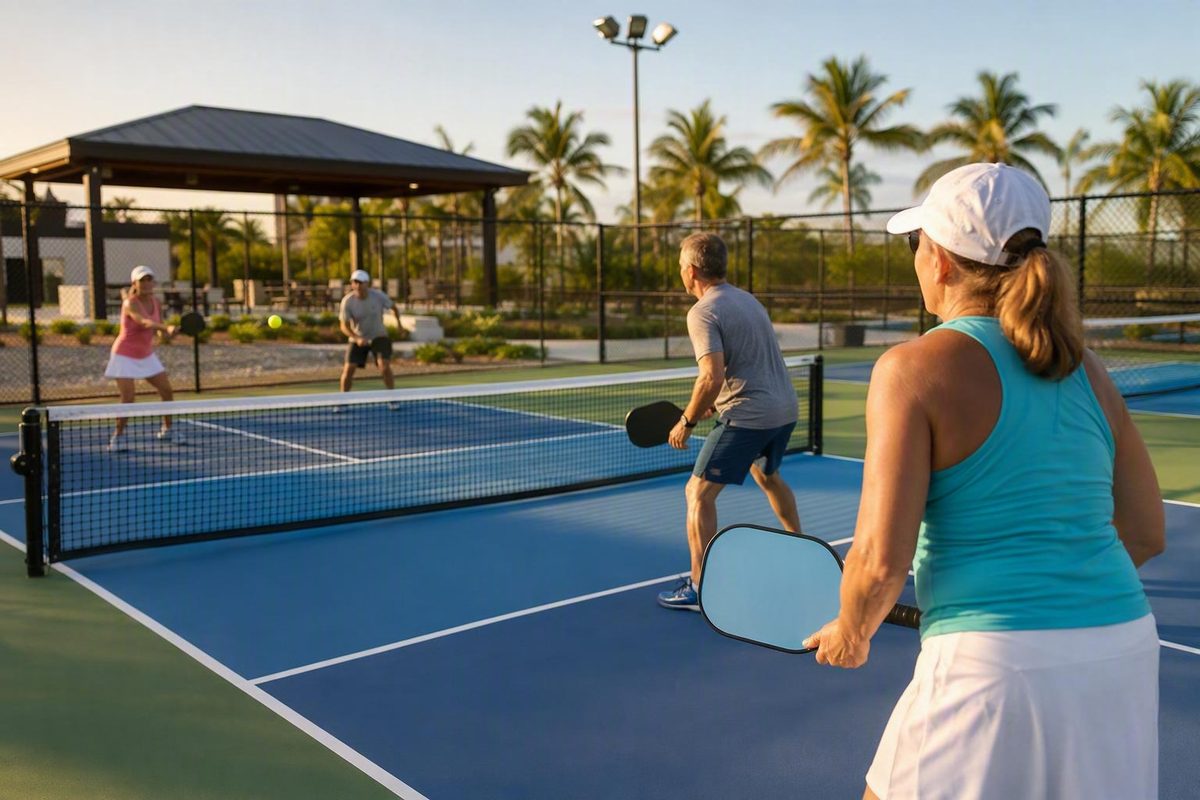
Vendor planning ranges, per-court lighting and fencing add-ons, and why public court budgets mislead, with an estimator that builds your own planning envelope.
For preliminary 2026 planning, allow $25,000–$55,000 for one new outdoor pickleball court with base, playing surface, net, and lines. That figure comes from a commercial planning guide with no disclosed project sample or regional adjustment; it is not a verified national average or a contractor quote. Difficult ground, drainage work, premium surfaces, fencing, lighting, electrical upgrades, and other amenities can move a residential project toward $80,000–$100,000 or more. (PickleTile 2026 cost guide)
The dependable number for a particular property comes from defining the entire scope, inspecting the site, and comparing several itemized local bids.
Pick your scope and add-ons; the planning range updates beside the controls.
Pickleball Court Planning-Range Estimator
Optional: more than one court
Excludes major drainage, electrical service upgrades, permits, design and contingency.
| Line | Low | High |
|---|---|---|
| New court (base, surface, net, lines) | $25,000 | $55,000 |
Reference ranges used
| Item | Low | High |
|---|---|---|
| Resurface or overlay a sound slab | $5,000 | $15,000 |
| New single outdoor court | $25,000 | $55,000 |
| Premium or difficult residential | $50,000 | $100,000+ |
| Lighting, per court | $4,000 | $12,000 |
| Fencing or windscreen, per court | $5,000 | $20,000 |
Source: PickleTile 2026 commercial planning ranges; the premium band also draws on Lone Star Surface Pros Dallas–Fort Worth estimates. Arithmetic sums, not quotes; no regional adjustment.
Plan Around Scope, Not One National Average
A regional contractor serving Dallas–Fort Worth reports $25,000–$60,000 for backyard courts, $50,000–$80,000 for premium residential courts, and $60,000–$150,000 or more for commercial projects. Its broader range for professionally constructed courts is $25,000–$100,000 or more, depending on site conditions and specifications. These are contractor-provided regional estimates, not national benchmarks or guaranteed prices. (Lone Star Surface Pros pricing guide)
| Project scope | Planning range | What it generally covers |
|---|---|---|
| Resurface or overlay a sound slab | $5,000–$15,000 | Renewal or overlay of a suitable existing base |
| Common new single outdoor court | $25,000–$55,000 | Base, surface, net, and lines |
| Premium or difficult residential project | $50,000–$100,000+ | More site work, upgraded construction, or added amenities |
The first two figures are PickleTile commercial planning ranges. The premium envelope combines that guidance with the Dallas–Fort Worth contractor estimates. None is an independently established average. Soil, access, drainage, surface specification, fencing, lighting, and utility work can push the final price outside these bands.
Why an $8,000 Court Becomes a $50,000 Project
VersaCourt advertises a typical $8,000–$12,000 range for its modular court system, but the same vendor says excavation, subsurface preparation, concrete, accessories, and shipping are excluded. Price also depends on dimensions, grading, base construction, customization, and who installs it. The advertised range is not an $8,000–$12,000 turnkey construction quote. (VersaCourt cost guide)
A low headline price often describes the playable surface or a packaged court, not everything needed to turn bare ground into a finished facility.
| Line item | Turnkey project | Package price |
|---|---|---|
| Excavation and grading | Yes | Often excluded |
| Drainage and soil correction | If required | Often excluded |
| Sub-base and pavement | Yes | Often excluded |
| Acrylic or modular surface | Yes | Sometimes included |
| Striping | Yes | Often included with surface |
| Net and posts | Specify | May be optional |
| Fencing and gates | Specify | Commonly optional |
| Lighting and electrical work | Specify | Commonly optional |
| Shipping and mobilization | Specify | May be excluded |
| Installation labor | Specify | DIY packages exclude it |
| Permits and inspections | Specify | Commonly excluded |
| Cleanup and restoration | Specify | Commonly excluded |
“Court included” is not a complete scope. Ask whether the price covers only the surface, a surface-and-equipment package, or a finished project that starts with the existing site and ends with cleanup. The available vendor guidance does not support a dependable dollar or percentage saving for any of these package routes.
Do not compare bids by headline total until every bidder has priced the same footprint, base, surface system, equipment, utilities, amenities, and closeout work.
Build New, Reuse a Slab, or Convert a Tennis Court
These are three materially different projects.
Greenfield construction on bare ground carries the fullest scope: equipment access, excavation, grading, soil correction, drainage, sub-base, pavement or concrete, surfacing, equipment, and optional amenities.
Resurfacing or overlaying a sound slab sits at the $5,000–$15,000 PickleTile allowance, though the guide does not disclose its methodology. The slab must first be evaluated for movement, cracking, slope, drainage, dimensions, and compatibility with the proposed surface.
Converting an existing tennis or hard court may reuse substantial base and site work. Conversion can still require crack repair, resurfacing, new lines, net systems, fencing changes, drainage correction, or accessibility work. The evidence does not establish a universal savings percentage.
Public conversion records show why scope matters, but they do not yield clean per-court benchmarks. Siler City, North Carolina, considered a $74,000 budget request to resurface and restripe existing tennis courts, complete minor repairs, and use movable nets that preserved tennis play. Contractor prices were still being gathered, the project was incomplete, and the record did not say how many pickleball courts would result. (Siler City agenda and budget record)
Jupiter, Florida, considered a $339,300 contract ceiling for converting three tennis courts and a roller hockey rink while also resurfacing and repairing three other tennis courts. The amount covered a combined project across two parks and was not allocated among the resulting courts, so dividing it by an assumed court count would mislead. (Jupiter contract record)
An existing paved area creates value only when inspection confirms its structure, dimensions, slope, drainage, and condition suit the new system.
The Line Items That Move the Final Price
A complete budget is easier to test when split into four buckets.
Hard construction: mobilization and equipment access; excavation and grading; unsuitable-soil removal; drainage; compacted sub-base; asphalt, conventional concrete, reinforced concrete, or another specified base; acrylic coating, cushioned coating, or modular tile; line painting; net posts, sleeves, anchors, and net.
Optional amenities: perimeter fencing, gates, and windscreen; court and pathway lighting; electrical panels, trenching, conduit, controls, and service upgrades; extra game lines, logos, and custom colors; benches, shade, and storage; landscaping and screening; sound mitigation where the site or approval process requires it.
Soft costs: site planning and design; permit and application fees; surveying or engineering; project management; inspections; accessibility-related design and construction.
Contingency: carry it as a separate line tied to identifiable uncertainties such as soil, drainage, buried utilities, electrical capacity, restricted access, and unresolved approval conditions. No single percentage fits every property.
PickleTile’s commercial guide places lighting at $4,000–$12,000 per court and fencing or windscreen at $5,000–$20,000 per court. Adding both to a $25,000–$55,000 base gives an arithmetic planning envelope of roughly $34,000–$87,000: $25,000 plus $4,000 plus $5,000 at the low end, and $55,000 plus $12,000 plus $20,000 at the high end. (PickleTile planning ranges)
That sum is not a quote. It assumes the three ranges combine without overlap and leaves out major drainage, electrical-service upgrades, seating, landscaping, design, permits, and sound control.
The largest unknowns generally need a site visit. Restricted access changes excavation and delivery methods. Poor drainage may need more than surface correction. Unsuitable soil alters the base design, and lighting may require trenching, panel work, or a service upgrade.
Size the Full Footprint, Not Just the Playing Lines
A regulation pickleball playing rectangle is 20 by 44 feet, or 880 square feet. Construction normally extends well beyond those lines.
Pricing only the lined rectangle understates how much land must be cleared, graded, drained, paved, surfaced, fenced, and lit. It also produces incompatible bids if one contractor assumes 880 square feet while another prices the complete paved envelope.
Put these details on every request for quotation: playing lines of 20 by 44 feet, the exact proposed paved footprint, fence position and gate layout, clearances and circulation, and orientation, elevations, and drainage direction.
Surface-system details can affect edge design too. VersaCourt says its modular plastic tile may expand or contract by approximately 2–3 inches, requiring a thermal-movement allowance. That specification applies to the vendor’s tile system and should not be transferred to acrylic coatings or other modular products. (VersaCourt product guidance)
Asphalt, Concrete, Post-Tensioned Concrete, and Modular Tile
The structural base and the playable surface are separate decisions. Asphalt or concrete forms the base; acrylic coating, a cushioned system, or modular tile forms the surface above it.
| Option | Likely budget effect | Watch for | Evidence limit |
|---|---|---|---|
| Asphalt base | May reduce upfront cost | Climate, soil, drainage, maintenance | Not universally cheaper or less durable |
| Reinforced concrete | Often a higher initial specification | Reinforcement, joints, subgrade, access | Cost depends on design |
| Post-tensioned concrete | May add a substantial premium | Crack-control goals, ownership horizon, specialist availability | Municipal projections do not prove universal savings |
| Modular tile surface | Adds a separate surface assembly | Prepared base, edge clearance, freight, repair method | Package prices may omit base and installation |
Asphalt can be a sensible lower-upfront-cost base on some sites, but it is not automatically the lowest bid in every market or the wrong long-term choice. Lifespan and future-savings claims should stay project-specific rather than being presented as guarantees.
Weston, Massachusetts, shows how material choice moves a bundled municipal estimate. Its preliminary project application presented an $80,000 deduction for substituting standard asphalt for post-tensioned concrete. The broader estimate also included mobilization, site preparation, earthwork, drainage, landscaping, design, contingency, and optional electrical and lighting work, so the deduction is not a one-court residential price. (Weston preliminary estimate)
Concord, Massachusetts, recorded an estimated $400,000–$500,000 premium for post-tensioned concrete within a wider replacement project that could include tennis, pickleball, and basketball work. The amount was a planning estimate, the final layout had not been selected, and the record did not isolate a pickleball-court cost. (Concord Recreation Commission minutes)
Modular tile may simplify assembly of the playable surface, especially when numbered sections are prepared before delivery. It does not remove the need for a flat, stable, properly drained base. Compare base construction, surface material, freight, assembly, linework, repair method, and warranty separately, and ask contractors to price defined alternatives against the same site assumptions and footprint.
Why Public Court Projects Cost Hundreds of Thousands
Municipal budgets do not show what one backyard court will cost. Public projects combine multiple courts with design, procurement, accessibility work, drainage, landscaping, public amenities, administration, and contingency.
Los Angeles County approved a $600,000 budget for two new pickleball courts plus tennis-court refurbishment, seating and viewing areas, landscaping, drainage, accessible walkways, design, permits, County services, civic art, and contingency. The budget allocated $417,000 to construction, $63,000 to contingency, and $120,000 to soft costs. It was an approved budget rather than a final expenditure, and dividing it by two would not produce a valid per-court figure. (Los Angeles County project budget)
Weston’s preliminary estimate carries the same lesson: the court work sat inside a larger package of site preparation, earthwork, drainage, landscaping, design, contingency, and optional lighting. Public records expose hidden scope; they do not generate residential unit prices.
Read every government figure according to its status. A planning estimate is an early forecast used to evaluate options. A budget request is funding sought, not necessarily approved or competitively priced. A bid solicitation defines scope and may contain no price at all. A submitted bid is one contractor’s offer, subject to review. An approved budget is spending authority, not the amount spent. A contract ceiling is the maximum authorized amount, which may differ from final payment. Only a final expenditure records what was actually paid.
Culpeper County’s 2022 solicitation, for example, specified four courts on a 128-by-68-foot concrete pad and set out contractor requirements, but contained no submitted bid, contract award, or project price. It is evidence of scope, not cost.
How to Make Contractor Quotes Comparable
Send every bidder the same written scope and require assumptions and exclusions to be stated explicitly.
| Category | Must be specified in every bid |
|---|---|
| Project definition | Court count, 20-by-44-foot lines per court, exact paved footprint, site plan and elevations, access assumptions, existing-surface reuse |
| Site and base | Clearing and export, grading and compaction, soil assumptions, drainage design and discharge, sub-base thickness, pavement type and thickness, reinforcement and joints, edge treatment |
| Playing system | Surface manufacturer and system, coating or cushion spec, tile model and assembly if used, color coats and lines, extra game lines, net posts and anchors, crack-repair allowance |
| Amenities and utilities | Fence height, material, gates, windscreen; fixtures, poles, controls, coverage; trenching, conduit, panel work, service; seating, shade, storage; landscaping and sound mitigation |
| Soft costs and closeout | Design and engineering, permits and inspections, accessibility work, freight and mobilization, taxes, restoration, debris removal, punch list and handover |
| Commercial terms | Schedule and weather rules, payment milestones, change-order markups, labor and material warranties, drainage-performance responsibility, crack-repair provisions, explicit exclusions |
Normalize the bids before comparing totals. An asphalt proposal is not directly comparable with a reinforced-concrete one. A lighting quote that includes fixtures but excludes trenching and electrical service is not a complete installation. Where choices remain open, request alternates so each contractor prices the same change.
How Often an Acrylic Court Needs Resurfacing
Lone Star Surface Pros recommends resurfacing acrylic sports surfaces approximately every four to eight years, depending on use and environmental conditions. Treat that as Dallas-area contractor guidance, not a mandatory service interval.
Whether Owner Labor or Self-Management Cuts the Price
Possibly. Owner-managed procurement, trade coordination, or modular-tile assembly may reduce contractor labor or management charges, but it transfers scheduling, delivery, installation, storage, quality-control, and warranty responsibility to the owner. Ask bidders to price owner-performed work as an alternate rather than assuming a savings amount, and confirm who remains responsible for measurements, base tolerances, freight damage, drainage, storage, assembly, cleanup, and warranty claims.
Whether Fencing and Lighting Come With the Quote
Not necessarily. Require every proposal to state whether fencing, gates, windscreen, fixtures, poles, controls, wiring, trenching, electrical connection, and related restoration are included.
The practical rule is to treat $25,000–$55,000 as a commercially sourced starting range for a common new outdoor court, not a national average. Expect more when the site needs substantial preparation or the design adds fencing, lighting, premium surfaces, or other amenities. Define the full footprint and specification, arrange a site inspection, and compare multiple local itemized bids with identical inclusions and exclusions.