
Pickleball vs. Tennis: The Differences That Change the Game
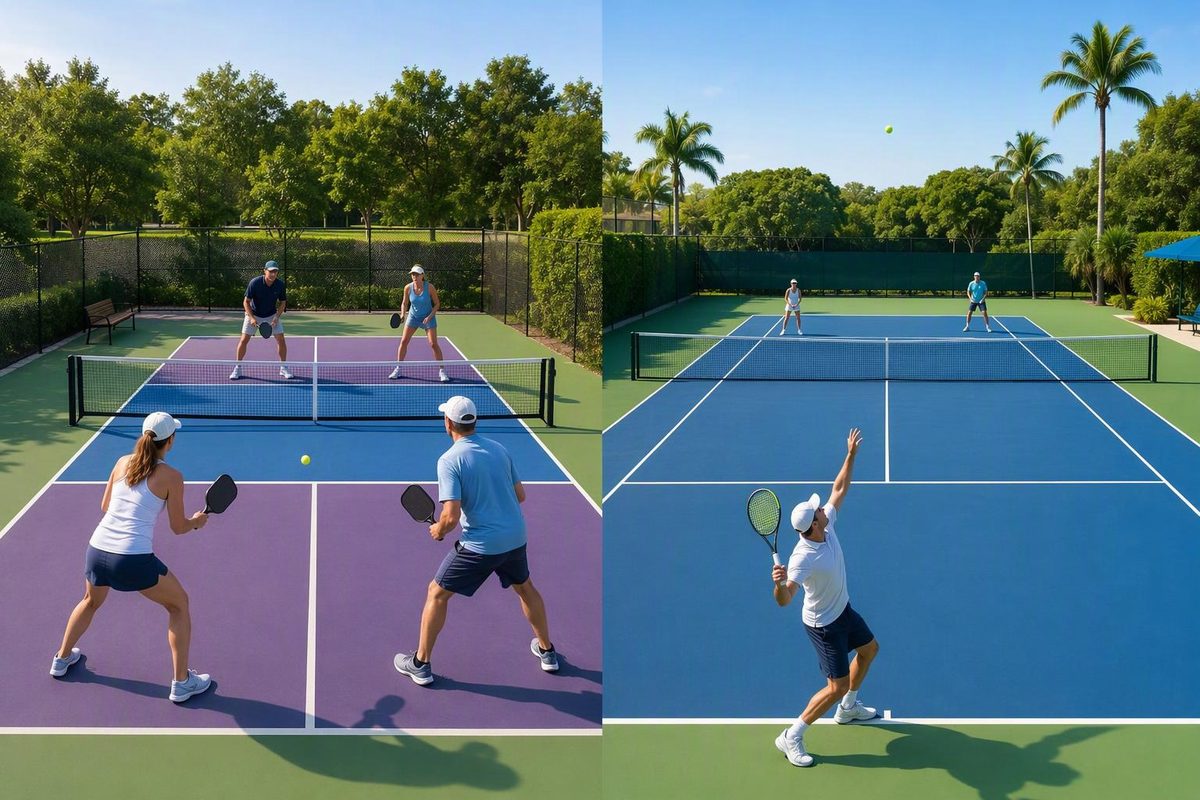
Compare pickleball and tennis court sizes, equipment, serving and scoring—and see why lined court area is not the same as facility space.
Pickleball uses a smaller court, a rigid-faced paddle and a perforated ball; tennis uses a larger court, a strung racket and a fabric-covered ball. The biggest rule differences are pickleball’s two-bounce opening sequence, its non-volley zone—or “kitchen”—and standard scoring that awards points only to the serving side.
Court size is also important when comparing facilities: a pickleball court’s lined area is ~31% of a doubles tennis court’s, but that does not mean three complete pickleball playing surfaces fit inside the tennis lines.
Pickleball vs. tennis at a glance
This comparison uses the 2026 USA Pickleball Official Rulebook and the ITF’s 2026 Rules of Tennis. It covers standard full-court play; adaptive rules, junior tennis courts and alternative scoring formats can differ. A volley means hitting the ball before it bounces.
| Feature | Pickleball | Tennis |
|---|---|---|
| Lined court dimensions | 20 × 44 feet for singles and doubles | 27 × 78 feet for singles; 36 × 78 feet for doubles |
| Lined court area | 880 square feet | 2,106 square feet for singles; 2,808 for doubles |
| Net height | 34 inches at center; 36 inches at sidelines | 36 inches at center; 42 inches at posts or singles sticks |
| Equipment | Rigid-faced paddle and perforated ball | Strung racket and fabric-covered ball |
| Serve | Restricted volley-serve motion or legal drop serve; no tennis-style second attempt after a service fault | Ball struck before it bounces; a second serve follows a first-service fault |
| Opening bounces | Both the serve and return of serve must bounce before being hit | The serve must bounce; the server can volley the return |
| Near-net restriction | A 7-foot non-volley zone on each side | No equivalent non-volley zone |
| Standard scoring | Serving side scores; games typically to 11, win by two | Love, 15, 30, 40, game; games build into sets and matches |
How much smaller is a pickleball court?
Multiply width by length to calculate the lined areas in the table. For doubles, the comparison is 880 ÷ 2,808 × 100 = ~31%. Against singles tennis, it is 880 ÷ 2,106 × 100 = ~42%. These are rounded calculations from official court dimensions, not estimates from a court inventory.
The distinction between court and playing surface matters. USA Pickleball specifies a minimum playing surface of 30 × 60 feet, including space outside the lines, and recommends 34 × 64 feet for new construction. Those footprints are 1,800 and 2,176 square feet respectively—not 880. Source: USA Pickleball, rules 3.A.1–3.A.3.
So a tennis-to-pickleball conversion cannot be assessed by dividing lined areas alone. The usable enclosure, runoff space and layout determine what fits. For the measurements behind that distinction, see pickleball court dimensions and space needed.
The same care applies to court inventories: pickleball lines on a shared tennis surface do not necessarily represent a separately available, dedicated court. Our guide to dedicated public versus total court counts explains the categories.
Serving and volleying work differently
Pickleball’s volley serve is often described as underhand, but the precise requirements matter at contact: the paddle must move in a clear upward arc, the ball must clearly be no higher than the server’s waist, and the paddle head’s highest point must clearly not be above the highest part of the wrist joint. A legal drop serve—hitting the ball after dropping it and letting it bounce—is another option; those three motion restrictions do not apply to it. Tennis requires the server to strike the released ball before it hits the ground, without pickleball’s waist-height restriction. Sources: USA Pickleball, rules 7.C–7.D; ITF, rule 16.
After a pickleball serve, the receiver lets it bounce and returns it. The serving side must then let that return bounce. Only after those two opening bounces can either side volley, subject to the kitchen rule. In tennis, the server can volley the return immediately. Sources: USA Pickleball, rule 10.A; ITF, rules 17 and 24.
The kitchen is not a no-entry zone. Players may enter it and hit a ball that has bounced. The restriction concerns volleying: contact with the zone or its boundary lines during a volley is a fault, including when the volley’s momentum carries the player into it afterward. After entering the kitchen, a player must place both feet completely outside it on the playing surface before volleying. Source: USA Pickleball, rules 3.A.4.c and 11.A.
Scoring changes what winning a rally means
In standard pickleball, winning a rally while receiving does not add a point. Instead, it advances the serving sequence or transfers the serve. Standard doubles gives both partners a serving turn before a side out, except for the team’s opening service rotation. Its three-number score call identifies the serving team’s score, receiving team’s score and server number. Source: USA Pickleball, sections 4–6.
Tennis awards the rally winner a point whether serving or receiving. Standard games use love–15–30–40, with deuce and advantage. In a standard tie-break set, the first player or team to win six games with a two-game lead wins the set; at 6–6, a tie-break decides it. Source: ITF, rules 5–6.
Not every pickleball match uses side-out scoring. The 2026 USA Pickleball rulebook also permits a provisional rally-scoring option, where each rally produces a point. That makes checking the format important before interpreting a score—or comparing match results. Source: USA Pickleball, rule 14.A. For the standard doubles sequence, see pickleball doubles rules.