
What Buffalo’s Four New Delaware Park Courts Actually Establish
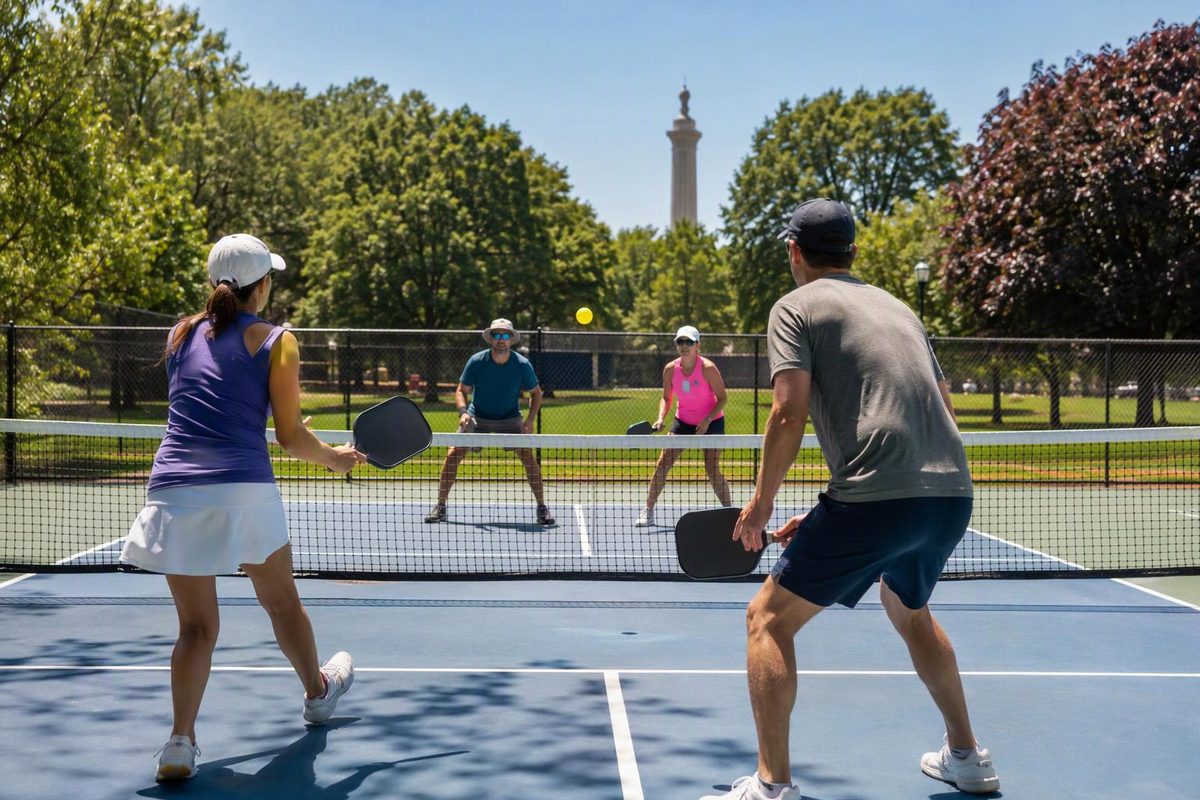
Buffalo’s Delaware Park has four reported municipal pickleball courts. Compare the opening dates, funding and limits of the city’s reported first-court claim.
Delaware Park has four pickleball courts, reported as Buffalo’s first municipal pickleball courts. They replace an old tennis-court area near Agassiz Circle, by the radio tower off South Meadow Drive. Buffalo Rising’s report supplies the court count and the municipal-first description. That claim concerns the City of Buffalo’s municipal courts, not every pickleball facility within the city or across Western New York.
Buffalo held the ribbon-cutting on September 21, 2026, and said the conversion used ~$120,000 in city parks funding. The city announcement confirms the project, location and funding, but does not explicitly state the court count or claim municipal-first status. The distinction matters: the official project announcement and the reported historical first support different parts of the story.
Choose what you’re recording; the tool identifies the figure and qualification to use.
Choose The Right Inventory Entry
These categories describe different parts of the same project.
4 Reported Courts
Record four courts at one Delaware Park location. This is not a complete Buffalo court inventory.
| Project Fact | Reported Value |
|---|---|
| Court count | 4 |
| Soft opening | Late July 2026 |
| Ribbon-cutting | September 21, 2026 |
| City parks funding | ~$120,000 |
| Funding ÷ four courts | ~$30,000 per court |
Scope And Missing Evidence
Buffalo Rising reports the four-court count and Buffalo municipal-first status. The city announcement confirms the project, funding and ceremony, but does not explicitly state the court count or first status.
The July soft opening has no exact day in the supplied reporting. The funding ratio is an arithmetic allocation, not an itemized construction price. Additional courts, selected expansion sites and a construction timetable are not provided.
Sources: Buffalo Rising (count and first claim); City of Buffalo (funding and ceremony); WIVB (soft opening). ~ means approximate.
Four Courts At One Municipal Park Location
The clearest inventory entry is a four-court municipal conversion at one Delaware Park location. The four courts are separate playing surfaces within the same project; they are not four facilities. A dataset counting places to play should record one location, while a dataset counting courts should record four courts at that location.
That distinction prevents a common comparison error. A city with several courts at one park can have a different distribution of access from a city with the same number of courts spread across several parks. The Delaware Park report establishes the size of this installation, but it does not establish how courts are distributed across Buffalo or how many residents live near them.
| Measure | Reported Figure Or Status | Source |
|---|---|---|
| Courts at this site | 4 | Buffalo Rising |
| Park locations in this project | 1 | Delaware Park project |
| City parks funding used | ~$120,000 | City of Buffalo |
| Opening ceremony | September 21, 2026 | City of Buffalo |
| Earlier availability | Late July 2026 soft opening | WIVB |
The one-location figure describes this project, not a citywide facility total. Similarly, the four-court figure should not be presented as Buffalo’s complete pickleball inventory. Neither the city announcement nor the reported first establishes a count of private facilities, shared-use courts or other nonmunicipal places to play.
The site’s previous use also belongs in the record. These pickleball courts replace an old tennis-court area; this is not a report of a new park built on a previously undeveloped site. For tracking the growth of pickleball infrastructure, “conversion” is more precise than an unqualified claim that Buffalo created four entirely new recreation spaces.
The draft’s sources do not give the number of tennis courts previously occupying the area. They therefore do not support a calculation of tennis courts lost, total racquet-sport courts gained, or the percentage change in the park’s overall court supply. The supported change is the reported installation of four pickleball courts at this location.
“First Municipal” Is A Qualified Reported Claim
Buffalo Rising describes the installation as Buffalo’s first municipal pickleball courts. The wording should stay attached to that source because the city’s announcement does not independently make the same historical claim. Calling the project “reported as Buffalo’s first municipal pickleball courts” preserves both the finding and its evidentiary limit.
“Municipal” is the decisive qualifier. It narrows the claim to city-provided courts rather than establishing the first occurrence of pickleball anywhere within Buffalo. Private clubs, other nonmunicipal facilities and places where players used shared surfaces are separate categories. The report does not supply their histories or counts.
The geographic boundary is equally important. A first for the City of Buffalo is not automatically a first for Western New York. Regional comparisons need records for the other municipalities and facilities included in that region. This project’s sources do not provide that broader inventory.
Nor does the wording prove that no Buffalo resident had played pickleball before these courts became available. A municipal infrastructure milestone is not a participation milestone. The opening adds a reported public provision of courts; it does not identify the sport’s first local players, first organized games or first local demand.
For a reference entry, keep the historical label separate from the physical count. “Four courts” answers how many are reported at the site. “First municipal” describes their reported place in Buffalo’s municipal history. One claim should not be used as evidence for the other without identifying which source supports it.
This is the same distinction that matters when comparing dedicated public courts with total pickleball court counts. A narrower public-court category can be useful, but it cannot stand in for every available playing surface. Delaware Park’s municipal-first description is meaningful within its stated scope, not as a complete account of Buffalo pickleball.
July Availability And September Ceremony Are Different Milestones
The two reported opening dates are not necessarily contradictory. WIVB reported a soft opening in late July 2026. The city’s ribbon-cutting took place on September 21, 2026. One describes earlier availability; the other identifies the official ceremony.
For a monthly court-addition dataset based on when people could begin playing, July is the supported opening month. The source gives “late July,” not an exact day. A database requiring a full calendar date should preserve that uncertainty rather than inventing a July date to satisfy its format.
For a timeline of formal city announcements or ribbon-cuttings, September 21 is the supported date. It is an exact date for that event, but should not be relabeled as the first day the courts were available. Doing so would move the reported start of play from July into September.
| Event | Supported Timing | Appropriate Use |
|---|---|---|
| Soft opening | Late July 2026 | First reported availability |
| Ribbon-cutting | September 21, 2026 | Official ceremony |
An inventory that retains both milestones can answer both questions without changing the underlying facts. Its availability field can contain “late July 2026,” while a separate ceremony field contains “September 21, 2026.” The source and date precision should travel with each entry.
The project should also be counted only once. A July report of availability and a September ceremony concern the same installation, not separate batches of courts. Adding four courts for each milestone would double-count the project. The dates describe its progression, not an increase from four to eight courts.
The supplied reporting does not give a construction start date, the exact day of the soft opening or a detailed sequence of work completed between the two milestones. Those gaps limit any construction-duration calculation. They do not prevent a record from distinguishing reported availability from the formal celebration.
The Funding Works Out To Approximately $30,000 Per Court
The reported city parks funding was ~$120,000. Dividing that amount by the four reported courts gives ~$30,000 per court. The calculation is approximately $120,000 divided by four courts, equaling approximately $30,000 in reported project funding per court.
Both the wording and the approximation belong with the result. The city described funding used for the conversion; the supplied announcement does not provide an itemized construction account. The calculation allocates the reported funding evenly across the court count. It does not establish that each individual court cost exactly that amount to build.
| Funding Measure | Amount | Meaning |
|---|---|---|
| Reported city parks funding | ~$120,000 | Project-level figure |
| Arithmetic allocation per court | ~$30,000 | Funding divided by four |
| Itemized construction price | Not provided | Cannot be established |
This is also a conversion of an existing tennis-court area. The sources do not break out spending on surfacing, nets, fencing or other work, so the figure cannot reveal which components drove the expenditure. They also do not establish what existing infrastructure could be reused or what a comparable project at an undeveloped site would require.
For those reasons, ~$30,000 is not a general new-court cost benchmark. It is a project-specific ratio built from two reported inputs: funding and court count. A cost comparison would need matching definitions across projects, including whether each figure represents the same kinds of work and spending.
The sources do not supply those comparable figures here. They also do not provide an operating budget or maintenance cost for the courts. The project funding therefore cannot be used to calculate annual cost per player, cost per visit or the long-term cost of keeping the installation available.
Keeping the ratio is still useful. It makes the scale of the reported funding easier to interpret alongside the four-court count, provided the entry is labeled “reported project funding per court.” Labeling it simply “construction cost per court” would claim more precision and scope than the announcement supplies.
Potential Expansion Is Not A Completed Court Count
The city said residents had expressed interest in courts at other parks and that it was evaluating potential locations. That establishes interest and an evaluation process, not another completed installation. The September announcement gives no additional court count, selected sites or construction timetable.
Those possible future courts should stay outside the completed-court tally. They cannot be assigned to a park, opening month or funded project from this announcement alone. Recording them as existing courts would turn a statement about considering locations into a claim about delivered infrastructure.
A separate planning note can retain the information without overstating it: the city was evaluating potential locations following resident interest. That note should not imply approved construction or a promised opening date. The supplied evidence stops before either milestone.
The reported interest also cannot be converted into a participation estimate. The announcement does not give the number of residents requesting courts, the number of current players or expected usage at Delaware Park. It supports a qualitative statement about interest, not a measure of demand or a forecast of how quickly the courts will fill.
The Supported Record Leaves Visitor Details Unresolved
For someone locating the project, the supported description is the former tennis-court area near Agassiz Circle, by the radio tower off South Meadow Drive. That is the location information supplied by the reporting. It is more specific than simply naming Delaware Park, without inventing an address or access route.
The supplied sources do not establish hours, reservation arrangements, fees, lighting, organized-play schedules or equipment availability. Municipal status alone does not answer those questions. A visitor-facing listing should leave them unconfirmed rather than assuming that public ownership guarantees any particular access arrangement.
The same restraint applies to conditions and capacity. Four reported courts do not establish current surface condition, how many courts are available at a given moment or whether players face a wait. No usage observations or attendance figures accompany the project data here.
The defensible summary is therefore narrow but useful: one Delaware Park conversion with four reported pickleball courts, a late-July soft opening, a September 21 ribbon-cutting and approximately $120,000 in city parks funding. Buffalo Rising supplies the reported municipal-first status. Potential expansion, a complete citywide inventory and itemized costs remain outside what these sources establish.