
Collegiate Pickleball: Why Schools, Teams and Players Are Different Counts
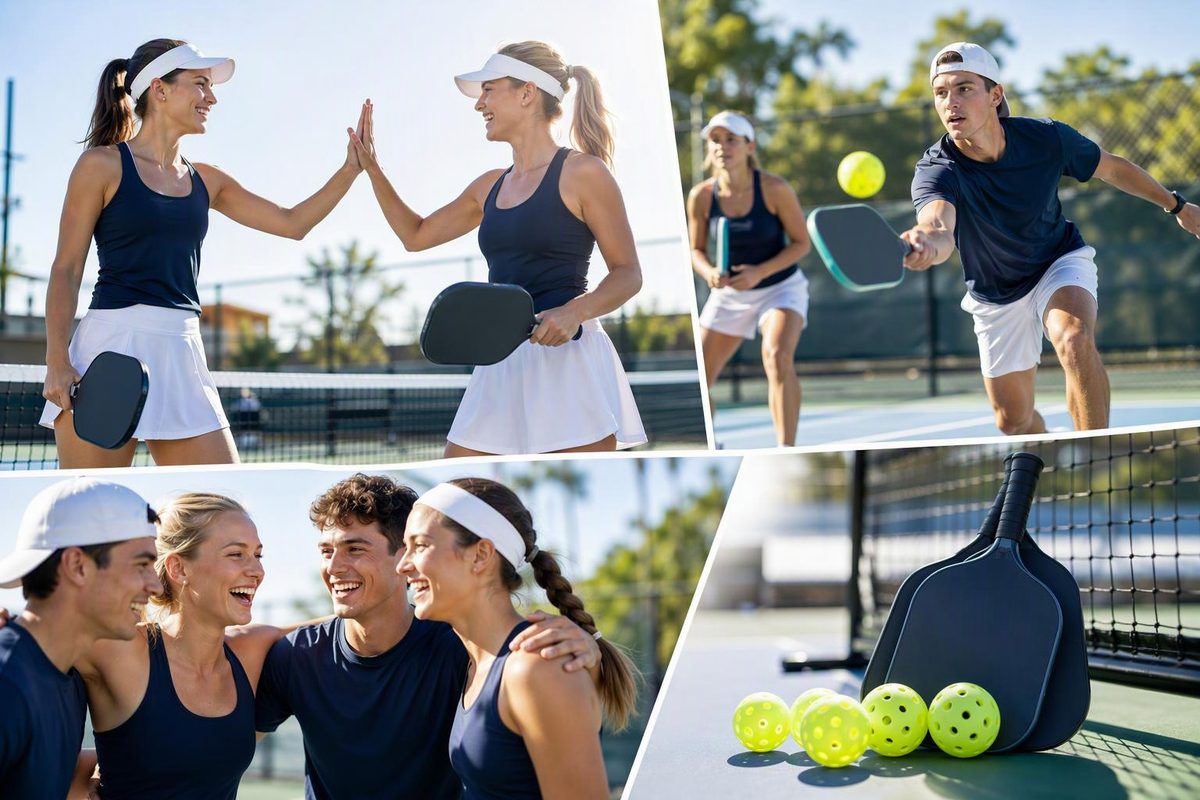
Compare collegiate pickleball circuits, 2026 championship figures and 2026–27 eligibility rules without confusing teams, schools and unique players.
Collegiate pickleball includes campus clubs, school-backed teams and intercollegiate tournament competition. One measure of its competitive scale: DUPR reports 64 schools, 112 teams and more than 700 players at the College Pickleball Tour’s 2026 Nationals in Peachtree Corners, Georgia. Those are figures for one event—not a census of U.S. college students who play pickleball. Source: DUPR’s event recap.
As of October 25, 2026, the most useful way to understand the sector is to separate its competition organizers, distinguish schools from team entries, and keep completed-event totals apart from future field sizes.
Who organizes collegiate pickleball?
There is more than one collegiate competition system. A “national champion” claim needs the organizer and season attached.
- College Pickleball Tour (CPT): DUPR says the tour became a partnership between DUPR and UPA in 2025. It runs events, develops college clubs, publishes rankings and establishes player eligibility. Florida Atlantic University won its 2026 Nationals. Tour history; 2026 results.
- APP Selkirk Collegiate Series: The Association of Pickleball Players works with USA Pickleball, the National Intramural and Recreational Sports Association (NIRSA), and Selkirk. Its announced 2026–27 schedule has eight qualifiers leading to the APP Selkirk U.S. Collegiate Championships in Las Vegas, March 12–14, 2027. APP’s season announcement.
- National Collegiate Pickleball Association (NCPA): The NCPA describes its own regional tour, conference leagues and national championship, with D1, D2 and D3 competition for teams and individuals. Those are NCPA competition labels; they should not be presented as NCAA divisions. NCPA’s competition overview.
What the available numbers actually measure
| Record or announcement | Published figure | What it measures |
|---|---|---|
| DUPR’s inaugural 2022 championship, Dripping Springs, Texas | 16 programs | Programs represented at that tournament, according to DUPR’s history |
| CPT’s 2026 Nationals, Peachtree Corners, Georgia | 64 schools; 112 teams; more than 700 players | Organizer-reported event totals, with three different counting units |
| PickleballTournaments listing for the April 9–11, 2026 CPT Nationals | 321 registered players | Registrations on a page designated for singles, Challenger and high-school brackets—not the entire event |
| Announced 2027 APP Selkirk U.S. Collegiate Championships | 48 teams | Planned championship field: 32 automatic qualifier bids plus 16 at-large bids |
The reported 2026 CPT school figure is four times the inaugural event’s 16 programs. That indicates increased school representation at those championships, not a fourfold increase in nationwide student participation.
The 321-player listing also does not contradict DUPR’s broader total by itself: its stated registration scope is narrower and includes high-school brackets. Neither figure supplies a college-only, deduplicated nationwide count, and the recap does not explain how its player total was counted.
Likewise, 112 teams cannot be relabeled as 112 colleges when the same recap identifies 64 schools. And APP’s planned 48-team field is not yet an observed turnout figure. These distinctions also matter when comparing the biggest pickleball tournaments.
School-backed does not automatically mean NCAA
A university athletics department can support pickleball outside NCAA competition. Drury University’s November 2023 launch announcement explicitly placed its new co-ed team among its non-NCAA sports offerings for 2024–25. It announced a full-time head coach, scholarship opportunities, an operating budget and an on-campus facility. Drury also publishes a 2026–27 pickleball roster. Source: Drury’s program announcement.
For a prospective player, that means “club,” “athletics-department program” and “NCAA sport” are not interchangeable descriptions. Ask the school what support and funding actually accompany its team.
Eligibility depends on the circuit and season
Key 2026–27 CPT eligibility rules include:
- Enrollment: Undergraduates generally need at least 12 credit hours or school-recognized full-time status; graduate students need at least six credits. Players must be in a degree-seeking program. There is a final-semester exception for students who need fewer credits to finish their degree.
- Documentation: Players submit an eligibility form and registrar’s letter at least once per semester. They must also have a high-school diploma or equivalent.
- Five-season clock: A player’s first game in a CPT-associated event in 2026–27 or later starts a five-season clock that runs without pausing. Earlier participation does not start that clock.
The rules also govern which school a player may represent. Consult the full CPT eligibility rules before entering an event.
APP’s 2026–27 announcement likewise specifies minimum enrollment of 12 undergraduate credits or six graduate credits, and permits scholarships, sponsorships and name/image/likeness benefits. Do not assume CPT’s five-season rule applies to APP simply because the credit requirements resemble each other. APP’s announcement.
For tracking growth, keep three separate records: active school programs, unique eligible competitors during a defined season, and students participating recreationally. Championship entries establish competitive activity; measuring the broader campus population requires club membership records or a participation survey with a stated definition of “player.”